I’ve spent a lot of time over the last several days thinking about automated license plate readers, talking with our police department, listening to residents, and reading more about the legal and privacy questions surrounding this technology.
My position is pretty straightforward.
ALPR is powerful technology. It can also be incredibly useful. It can help police locate stolen vehicles, find missing people, and develop leads in serious criminal investigations. I don’t believe we should take an effective tool away from law enforcement because it has been misused.
But that misuse is real. And it raises legitimate concerns.
There have been documented cases around the country where ALPR information has been accessed or used improperly. Any technology that allows government to collect and search information about where people have been deserves meaningful safeguards.
That doesn’t mean I believe West Jordan police officers are misusing the system. I have seen no evidence that they are.
But good government shouldn’t depend on trust.
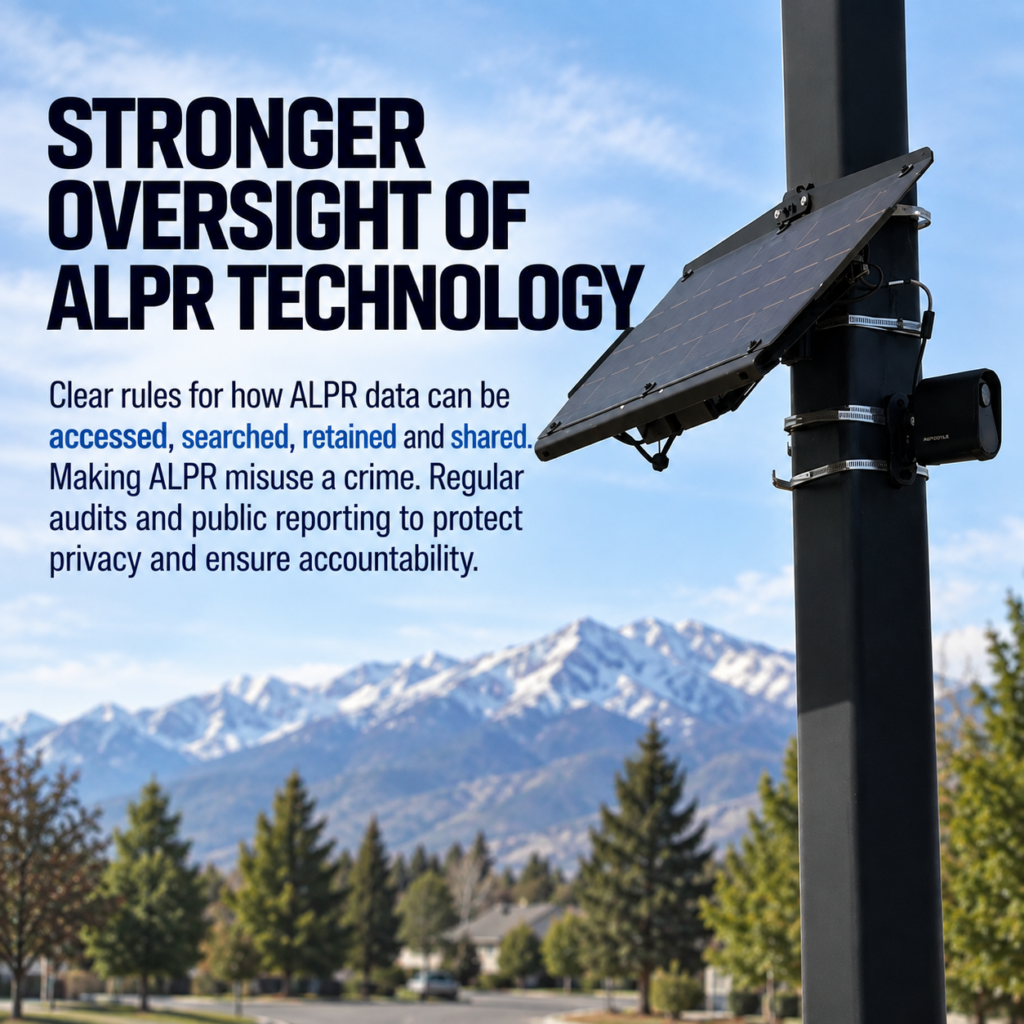
My approach is simple: establish clear rules about how the technology can be used, audit its use to make sure those rules are being followed, create meaningful consequences for misuse, and provide enough public reporting that residents and elected officials can evaluate whether the system is operating as intended.
Some of those protections already exist in state law and police department policy. I believe some of the most important safeguards should also be established in city ordinance so they cannot simply change administratively.
There is also a legitimate Fourth Amendment question here.
Historically, courts have treated a person’s movements on public roads differently from activity occurring in private places. But modern technology can collect and aggregate public observations on a scale that simply wasn’t possible before.
That raises a difficult question: can enough individually public information be aggregated into something in which a person has a reasonable expectation of privacy?
The Supreme Court has moved toward that question in cases involving GPS tracking and historical cell-site location information, but it has not yet given us a definitive answer for modern ALPR networks. Courts around the country have been wrestling with it, and the Supreme Court now has an opportunity to provide greater clarity.
I’m not going to pretend that constitutional question is already settled simply because a lot of passionate people have very strong opinions.
When the courts establish the constitutional boundary, West Jordan will follow it. If certain searches require a warrant, we will require a warrant. If certain uses are prohibited, we will prohibit them. If the Court determines that other uses are constitutionally permissible, we can still decide as a community whether additional safeguards make sense.
We don’t have to wait for a Supreme Court decision to practice good government.
My position isn’t “ALPR is good” or “ALPR is bad.”
It is that powerful technology deserves powerful oversight.
Use it when it legitimately helps law enforcement do its job. Put clear boundaries around that use. Audit it. Make misuse consequential. Tell the public enough about how it is being used that they can hold us accountable.
And as the technology and the law evolve, be willing to change our rules with them.
That’s the approach I’m working toward in West Jordan.